
Sitting Trap
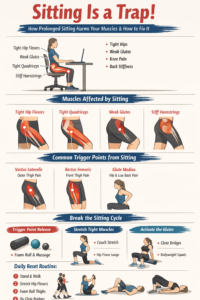 Sitting Is a Trap: Why Your Body Was Never Designed for the Chair
Most modern people spend 6–10 hours a day sitting. We sit in cars, at desks, on couches, and at dinner tables. At first glance, sitting seems harmless—even restful.
But from a musculoskeletal perspective, prolonged sitting is one of the most powerful posture traps in modern life.
When you sit for long periods, several muscles tighten, others weaken, circulation slows, and trigger points develop. Over time this can lead to:
Quadriceps tightness
Hip flexor shortening
Lower back stiffness
Knee pain
Reduced mobility
Fatigue in the legs
If you help people with mobility, massage, acupressure, or exercise, understanding the “sitting trap” is essential.
Let’s break down what actually happens in the body—and how to escape it.
The Sitting Trap: What Happens to Your Muscles
Your body evolved for movement, walking, and standing. Sitting places many muscles in a shortened position for hours at a time.
The biggest victims include:
1. Hip Flexors (Psoas & Iliacus)
When sitting, the hip is flexed to roughly 90 degrees.
This keeps the psoas and iliacus shortened all day.
Over time this can cause:
Tight hips
Anterior pelvic tilt
Low back tension
Difficulty standing fully upright
Trigger points in the hip flexors may cause:
Deep groin pain
Front hip stiffness
Lower back ache
2. Quadriceps
The rectus femoris, one of the quadriceps muscles, crosses both the hip and knee.
When sitting:
The hip is flexed
The knee is bent
This places the quadriceps in a shortened state for hours.
Over time this leads to:
Tight quadriceps
Trigger points in the vastus lateralis
Knee tension
Limited stride while walking
Many people working through quadriceps release programs discover that sitting habits are the real cause of recurring tension.
3. Gluteal Muscles
While sitting, the glutes are largely inactive.
This leads to what many clinicians call:
“Gluteal inhibition” or “sleepy glutes.”
Consequences include:
Reduced hip stability
Increased stress on the knees
Compensation by the lower back
When the glutes weaken, the quadriceps and hip flexors often become overworked, increasing trigger point formation.
4. Hamstrings
It may seem surprising, but sitting also stresses the hamstrings.
Because the pelvis tilts backward while slouching:
Hamstrings become tension-loaded
Circulation decreases
Trigger points can develop near the sitting bones
This can create symptoms like:
Tightness when standing
Pulling behind the knee
Difficulty bending forward
Common Trigger Points Caused by Sitting
Prolonged sitting often creates predictable trigger point patterns.
Vastus Lateralis Trigger Points
Location: Outer thigh
Symptoms:
Outer knee pain
Achy thighs
Sensitivity when pressing the muscle
This is one of the most common trigger points in people who sit frequently.
Rectus Femoris Trigger Points
Location: Middle of the front thigh
Symptoms:
Front knee pain
Stiffness when climbing stairs
Tightness during walking
Glute Medius Trigger Points
Location: Side of hip
Symptoms:
Hip pain
Lower back discomfort
Pain when standing from sitting
Hip Flexor Trigger Points
Location: Deep front hip
Symptoms:
Groin tightness
Lower back strain
Difficulty standing upright after sitting
The Hidden Problem: Circulation
Muscles are not just mechanical structures—they rely on circulation and movement.
When sitting for long periods:
Blood flow decreases
Lymphatic flow slows
Muscle metabolism drops
This contributes to:
Muscle fatigue
Stiffness
Trigger point formation
Reduced recovery
Even healthy muscles can become stiff and sensitive when circulation is restricted for hours.
Signs You Are Caught in the Sitting Trap
You may be dealing with sitting-related tension if you notice:
Stiff legs when standing up
Tight quadriceps
Achy hips
Knee discomfort when walking
Low back stiffness
Reduced stride length
Difficulty squatting
Many people assume these symptoms come from aging, when they are actually caused by prolonged sitting habits.
Escaping the Sitting Trap
The solution is not simply avoiding chairs. Instead, it is about restoring balance through movement and muscle care.
Three strategies are especially helpful.
1. Trigger Point Release
Self-massage can help deactivate tight areas created by sitting.
Common tools include:
Foam rollers
Massage balls
Acupressure techniques
Areas to target include:
Quadriceps
Vastus lateralis
Hip flexors
Glutes
A simple method:
Roll slowly on the muscle
Pause on tender points
Breathe deeply
Hold pressure for 20–30 seconds
This encourages the muscle to release tension and restore circulation.
2. Stretch the Muscles That Sitting Shortens
Several stretches help reverse the sitting position.
Couch Stretch
Targets:
Rectus femoris
Hip flexors
This stretch is extremely effective for people who sit for long hours.
Hold for:
30–60 seconds per side
Standing Quad Stretch
A classic stretch that lengthens the front of the thigh.
Focus on:
Keeping knees together
Standing upright
Avoiding lower back arching
Hip Flexor Lunge Stretch
This restores hip extension lost during sitting.
Key cue:
Gently tuck the pelvis while lunging forward.
3. Activate the Muscles That Sitting Turns Off
Weak muscles need activation.
The most important are the glutes.
Helpful exercises include:
Glute Bridges
Benefits:
Restores hip strength
Reduces stress on quadriceps
Improves pelvic stability
Squats
Squats encourage:
hip mobility
glute engagement
quadriceps balance
Start with bodyweight squats and progress gradually.
Walking
Never underestimate walking.
Walking:
stimulates circulation
restores natural movement patterns
reduces muscle stiffness
Even 5 minutes every hour can significantly reduce the negative effects of sitting.
A Simple Anti-Sitting Routine
Here is a simple daily reset routine:
Every 60 minutes:
Stand up
Walk for 2–5 minutes
Stretch the hip flexors
Roll the quadriceps (if tight)
At the end of the day:
Foam roll thighs
Stretch hip flexors
Perform glute bridges
This small routine can prevent many of the muscle imbalances caused by prolonged sitting.
The Big Picture
Sitting itself is not the enemy.
The real problem is uninterrupted sitting for hours without movement.
Your body thrives on:
movement
circulation
muscle activation
posture changes
When you interrupt sitting with small moments of movement, you prevent muscles from becoming trapped in shortened positions.
Final Thought
Sitting may feel like rest, but for your muscles it can become a hidden trap.
By understanding how sitting affects:
quadriceps
hip flexors
glutes
trigger points
circulation
you can take simple steps to keep your body mobile, strong, and resilient.
The key is simple:
Move often. Release tension. Restore balance.
Your muscles will thank you.
For educational purposes only. If pain persists see a provider.
Created with AI assist

Shop With Confidence ✔ 30-Day Money-Back Guarantee ✔ Safe & Secure Checkout ✔ Real Customer Support ✔ Quality You Can Trust