
Headache and Migraine relief
A Practical Guide Using Myofascial Release, Lymphatic Drainage & Acupressure
1. Understanding Headaches & Migraines (Brief Overview)
Headaches and migraines are multifactorial. Common contributors include:
Muscle tension (neck, shoulders, jaw, scalp)
Myofascial restrictions
Poor posture or prolonged screen use
Stress and nervous system overload
Impaired lymphatic or venous drainage
Trigger points referring pain to the head
Vascular and neurological sensitivity (especially in migraines)
Massage therapy does not replace medical care, but it is a powerful complementary approach
that can reduce:
Frequency
Intensity
Duration
Medication reliance (in some individuals)
2. Safety & Contraindications
Before beginning any massage technique:
Use caution or avoid massage if there is:
Sudden, severe “worst-ever” headacheHeadache with fever, confusion, weakness, or vision loss
Recent head or neck trauma
Blood clots, active cancer in lymph nodes, or infection (for lymphatic work)
For migraines:
Pressure should be gentle to moderate. Overly aggressive work may worsen symptoms.
3. Key Muscles & Fascia Involved in Headaches
Understanding anatomy improves results.
Common Muscles Involved
Suboccipitals (base of skull)
Upper trapezius
Levator scapulae
Sternocleidomastoid (SCM)
Temporalis
Masseter
Frontalis
Occipitalis
Fascial Connections
Superficial front line (forehead → chest)
Deep front line (neck → diaphragm)
Cranial fascia interconnected with jaw, neck, and shoulders
4. Myofascial Release (MFR) for Headache Relief
What It Is
A slow, sustained pressure technique aimed at releasing fascial restrictions rather than “rubbing
muscles.”
General Guidelines
Pressure: gentle to moderate
Duration: 60–120 seconds per area
Movement: slow, intentional, listening for tissue softening
Key Myofascial Release Areas & Techniques
A. Suboccipital Release (Major Headache Trigger)
Location:
At the base of the skull, just above the neck muscles.
Technique:
Client lying on back
Place fingertips under the occiput
Apply gentle upward pressure
Hold still, allowing tissue to melt
Breathe slowly
Benefits:
Reduces tension headaches
Calms nervous system
Often provides immediate relief
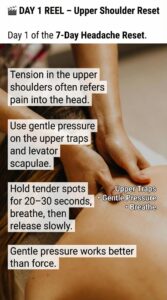
B. Upper Trapezius & Shoulder Fascia
Trigger Point Location:Soft area behind the ear lobes
Technique:
Gentle circular movements
Drain downward toward neck
6. Acupressure for Headaches & Migraines
Acupressure uses specific points to influence neurological and energetic pathways.
Essential Acupressure Points
1. LI4 – Hegu (Powerful Headache Point)
Location:
Web between thumb and index finger
Technique:
Firm pressure for 30–60 seconds
Not recommended during pregnancy
Benefits:
Relieves tension headaches
Helpful for facial pain
2. GB20 – Feng Chi (Migraine & Neck Pain)
Location:
Hollow at base of skull, just outside neck muscles
Technique:
Thumb pressure upward and inward
Hold while breathing deeply
Benefits:
Migraines
Eye strain
Neck stiffness
3. Taiyang (Temple Point)
Location:
Small depression at temples
Technique:
Gentle circular pressure
30–60 seconds
4. Yin Tang (Third Eye)
Location:
Between the eyebrows
Technique:
Light pressure or slow circles
Benefits:
Stress relief
Sinus pressure
Calming effect
5. GB21 – Shoulder Well
Location:
Top of shoulder midway between neck and shoulder jointTechnique:
Moderate pressure
Avoid during pregnancy
7. Trigger Point Referral Patterns (Summary)
Trigger Point
Referral Area
Suboccipitals
Back of head, behind eyes
Upper Trapezius
Side of head, temple
SCM
Forehead, eye, ear
Temporalis
Temple, jaw
Masseter
Jaw, ear, temple
8. Self-Massage Routine (10–15 Minutes)
Step 1: Deep breathing (1 minute)
Step 2: Supraclavicular lymph drainage
Step 3: Suboccipital hold
Step 4: Temple & jaw massage
Step 5: Acupressure points (LI4, GB20, Yin Tang)
Step 6: Gentle neck stretching
9. Professional Tips for Best Results
Encourage hydration after massage
Use slow pace and intentional touch
Combine with heat or aromatherapy (peppermint, lavender)
Track headache triggers for personalized care
Regular short sessions often work better than occasional deep sessions
10. When to Refer Out
Massage therapists and caregivers should recommend medical evaluation if headaches:
Are worsening
Change in pattern
Occur with neurological symptoms
Do not respond to conservative care
Final Note
Massage for headaches and migraines works best as part of a holistic approach—addressing
posture, stress, hydration, sleep, and nervous system regulation. 🌿Acupressure points (LI4, GB20
Created by Lucille Wenger LMT with AI assist
Shop With Confidence ✔ 30-Day Money-Back Guarantee ✔ Safe & Secure Checkout ✔ Real Customer Support ✔ Quality You Can Trust